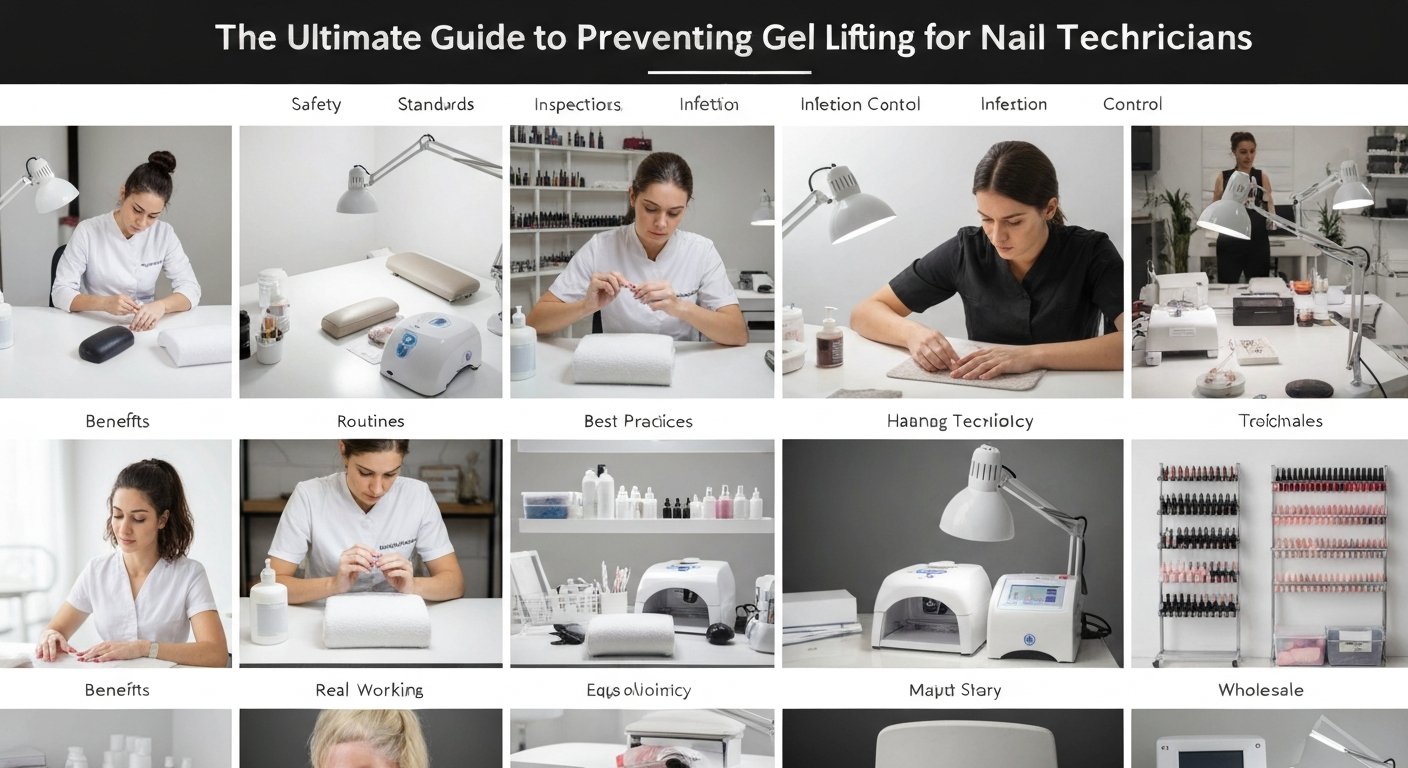
The Ultimate Guide to Preventing Gel Lifting for Nail Technicians
For any professional nail technician, client retention relies heavily on product retention. Nothing damages a nail salon’s reputation faster than a set of gel nails that lifts within a few days.
Lifting is the separation of the nail enhancement product from the natural nail plate. While it can be caused by client lifestyle, it is most often the result of technical errors during the service.
Mastering your workflow to eliminate lifting will increase your prices, fill your schedule, and build trust with your clientele. Here is how to achieve superior adhesion every time.
The Foundation: Immaculate Nail Preparation
90% of lifting issues stem from improper preparation. If the canvas is not perfectly clean and dry, the product cannot form a chemical bond with the keratin.
Deep Cuticle Work
Pushing back the eponychium is not enough. You must remove the true cuticle—the thin layer of dead skin that adheres to the nail plate.
If any non-living tissue remains on the plate, the gel will bond to the skin instead of the nail. As the skin sheds naturally, the product will lift away.
- Use a quality cuticle pusher to gently expose the cuticle area.
- Utilize an electric file with a fine diamond bit (if certified) to exfoliate the nail plate near the proximal fold.
- Ensure the lateral sidewalls are completely free of debris.
Surface Texture and Dehydration
Gel products need a textured surface to anchor onto. However, over-filing damages the nail and thins the foundation, leading to flexibility that causes separation.
Gently buff the shine off the natural nail using a 180 or 240-grit file or buffer. You are not removing layers; you are simply increasing the surface area for adhesion.
Once buffed, remove all dust with a stiff manicure brush. Dust is a major enemy of adhesion. Follow this by thoroughly cleansing the nail with 99% Isopropyl Alcohol or a professional nail cleanser to strip surface oils.
Chemical Bonding: pH Balancers and Primers
Once the nail is mechanically prepared, you must prepare it chemically. This step ensures the nail plate is compatible with your specific gel system.
Using Dehydrators
Apply a pH bond or dehydrator first. This product evaporates instantly, removing moisture and balancing the pH of the natural nail to an alkaline state, which promotes bonding.
Watch the nail turn chalky white. If it does not, you may need to apply a second coat, especially for clients with hyperhidrosis (sweaty hands).
Correct Primer Application
Primer acts as double-sided sticky tape. However, more is not better. Flooding the cuticle with acid-free primer can actually cause lifting and potential chemical burns.
Apply primer sparingly. Brush off excess liquid on the bottle neck before touching the nail. You only need a thin, even coat confined strictly to the natural nail plate.
Application Technique: Control is Everything
Even with perfect prep, poor application of the base coat or builder gel will result in service breakdown.
The Danger of Touching the Skin
If your gel touches the eponychium or sidewalls, lifting is inevitable. Once cured, that bridge of product between the nail and skin will pull away as the nail grows out.
Leave a tiny, invisible margin around the perimeter of the nail. If you flood the cuticle, clean it up with a brush dipped in alcohol before curing. Once it is cured, the damage is done.
Thin vs. Thick Layers
Applying gel too thickly prevents the light from penetrating to the bottom layer. This results in under-cured product sitting on the nail plate.
Work in thin, controlled layers. If you are using a builder gel or structure gel, build your apex gradually. This ensures a full cure and a stronger structure.
Curing Standards and Equipment
Your curing lamp is the heart of your technical service. Using an old or incompatible lamp is a silent killer of retention.
Lamp Compatibility
Not all UV/LED lamps cure all gel brands. Professional brands formulate their photo-initiators to react to specific wavelengths and intensities.
Use the lamp recommended by your gel manufacturer. A generic lamp may harden the top layer while leaving the base layer soft, leading to pocket lifting and bacterial infections (greenies).
Hand Placement
Educate your clients on proper hand placement. If they shove their hand too far in, or do not keep their hand flat, the light cannot reach the sides of the nail.
Pay special attention to thumbs. Cure thumbs separately if necessary to ensure the light hits the entire surface directly.
Summary for Salon Success
Preventing lifting is a science. It requires a strict adherence to sanitation, preparation, and application protocols.
Review your current workflow against these standards. Often, tweaking just one step—like dusting more thoroughly or changing your curing bulbs—can dramatically improve your retention rates and keep your clients returning every 3 to 4 weeks.
