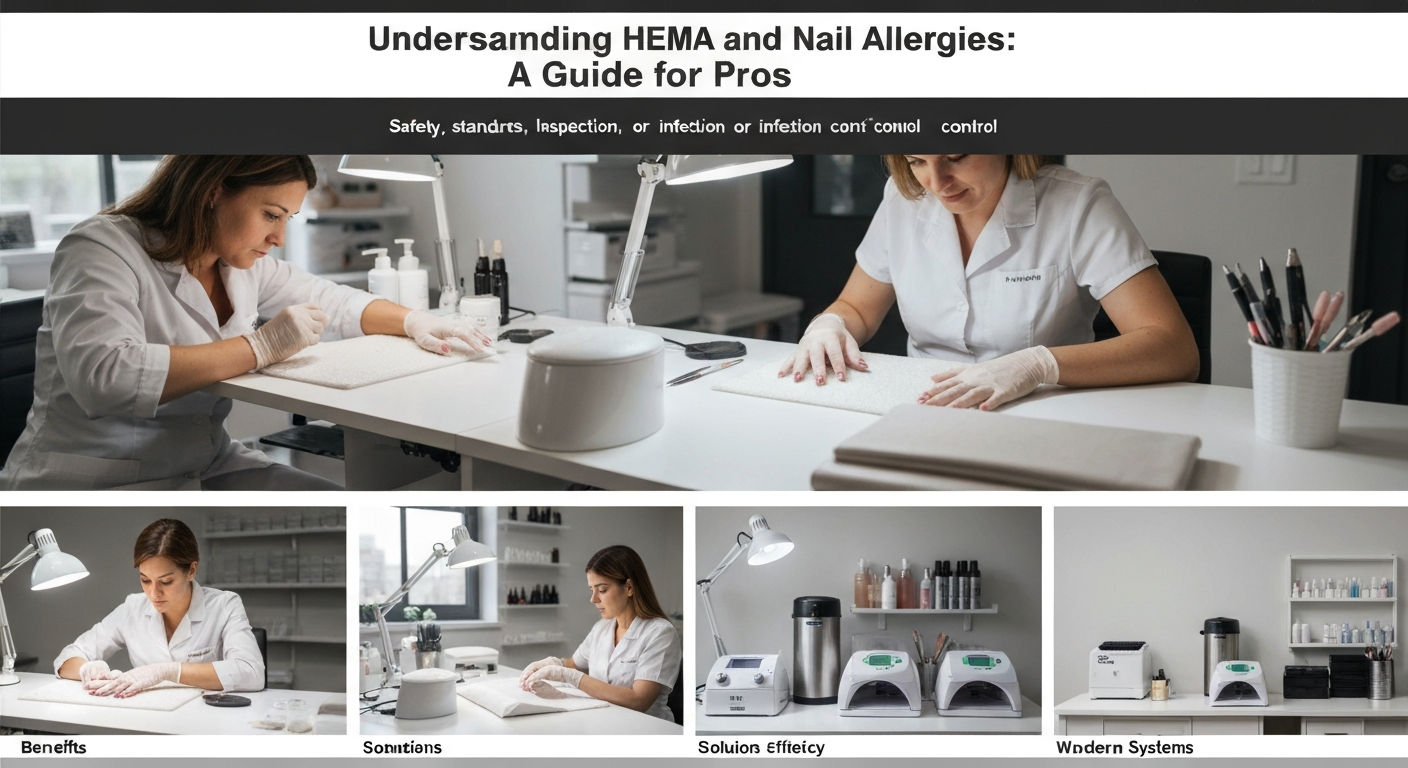
Understanding HEMA and Nail Allergies: A Guide for Pros
In the modern nail industry, gel polish and builder gels are standard services.
However, the rise in allergic reactions to acrylates has become a major concern.
Nail technicians must understand HEMA to protect their health and their clients.
What is HEMA and Why is it Used?
HEMA stands for Hydroxyethyl Methacrylate.
It is a monomer widely used in the formulation of UV gels and adhesives.
Manufacturers use HEMA because it is highly effective at polymerization.
It acts as a bonding agent, helping the gel adhere tightly to the natural nail plate.
It also creates a hard, shiny finish that resists chipping.
Because HEMA molecules are very small, they penetrate the nail plate easily.
The Problem: Allergic Contact Dermatitis
While HEMA provides great adhesion, its small molecular size is a double-edged sword.
The molecules can easily penetrate the skin barrier if uncured product touches the skin.
Repeated exposure to uncured HEMA can lead to Allergic Contact Dermatitis (ACD).
Once a nail technician or client develops an allergy, it is usually lifelong.
The immune system identifies the acrylates as a threat, reacting every time exposure occurs.
This can end a nail technician’s career if they become unable to work with standard products.
Common Signs of Overexposure
- Itching or redness around the nail folds and cuticles.
- Swelling or inflammation of the fingertips.
- Blisters forming under the nail plate or on the skin.
- Onycholysis (separation of the nail plate from the nail bed).
The Shift to HEMA-Free Gel Systems
To combat these issues, many professional brands now offer HEMA-free lines.
These products replace HEMA with larger molecules like HPMA or Bis-GMA.
Larger molecules do not penetrate the skin barrier as easily as HEMA.
Switching to HEMA-free products can significantly reduce the risk of new allergies.
However, “HEMA-free” does not mean “allergy-free.”
Safe working practices are still required to handle any UV-cured chemicals.
Best Practices for Infection Control and Safety
The most common cause of allergies is not the product itself, but improper application.
Touching the skin with wet gel is the number one cause of sensitization.
Follow these standards to maintain a safe salon environment.
1. Perfect Your Application Bead
Control your product ratio to prevent flooding the cuticle.
Leave a tiny margin (hairline space) between the product and the skin.
If product touches skin, remove it immediately before curing.
2. Proper Curing is Non-Negotiable
Undercured gel leaves active monomers on the nail that can leach into the skin.
Always use a lamp that is calibrated for your specific gel brand.
Ensure clients place their hand correctly in the lamp for a full cure.
3. Manage the Inhibition Layer
The sticky layer left after curing contains uncured monomers.
Avoid touching this layer with your bare hands or the client’s skin.
Remove it with isopropyl alcohol and a lint-free wipe immediately after the final cure.
4. Personal Protective Equipment (PPE)
Nail technicians should always wear nitrile gloves.
Latex gloves do not provide adequate protection against acrylates.
Change your gloves immediately if wet product touches them.
Educating Clients on Nail Health
Clients may ask why their nails are lifting or itching.
As a professional, you must explain the importance of high-quality products.
Warn clients against using DIY at-home gel kits, which often contain high HEMA levels.
By using safer products and strict application protocols, you build trust.
Your expertise in chemical safety distinguishes you from non-standard salons.
Prioritize health to ensure longevity for your business and your hands.
